

#69: Behind the Scenes of Bird Banding with Dr. Katie LaBarbera of the San Francisco Bay Bird Observatory – Nature's Archive
Summary
Have you ever wondered how bird banding works? How the birds are captured, safely handled, and released? And why is it done at all?
Thanks to Dr. Katie LaBarbera, Science Director for the Land Bird Program at SFBBO, we have you covered.
Banding is specifically the scientific technique used to study bird behavior, migration, and populations. By safely capturing and placing bands on birds’ legs, researchers can track their movements and gain valuable insights for conservation efforts.
Today’s episode is a unique one – it’s part field recordings and part traditional Nature’s Archive interview. We’ll jump into the entire banding process, from capture and extraction to the measurements taken and placing the band on it.
We’ll then discuss the outcomes and observations from this long term monitoring effort, along with some fascinating observations about birds ranging from American Goldfinch to Bewicks Wrens.
Katie also tells us about MOTUS, an exciting telemetry technology that will help create a network of automated observation stations to further advance bird migration monitoring. This technology promises to augment and amplify the work performed by banding stations.
And just one more thing. This was a really fun episode to produce, though challenging at times. A big thanks to Katie for allowing these visits despite a challenging season of weather disruptions, and having to re-record parts of it. Thank you to Wendy Gibbons, who walked us through the netting and extraction processes, as well as several other SFBBO volunteers who provided insights and information on my first visit in February.
Also find SFBBO on Instagram, Facebook, and Twitter.
Thanks to Emily Smith for production assistance in this episode.
Did you have a question that I didn’t ask? Let me know at naturesarchivepodcast@gmail.com, and I’ll try to get an answer!
And did you know Nature’s Archive has a monthly newsletter? I share the latest news from the world of Nature’s Archive, as well as pointers to new naturalist finds that have crossed my radar, like podcasts, books, websites, and more. No spam, and you can unsubscribe at any time.
While you are welcome to listen to my show using the above link, you can help me grow my reach by listening through one of the podcast services (Apple, Google, Spotify, etc) linked on the right. And while you’re there, will you please consider subscribing?
Links To Topics Discussed
People and Organizations
Wendy Gibbons – an SFBBO volunteer who walked me through the capture and extraction process in today’s episode.
Books and Other Things
Note: links to books are affiliate links
The Beak of the Finch by Jonathan Weiner
MOTUS Wildlife Tracking System
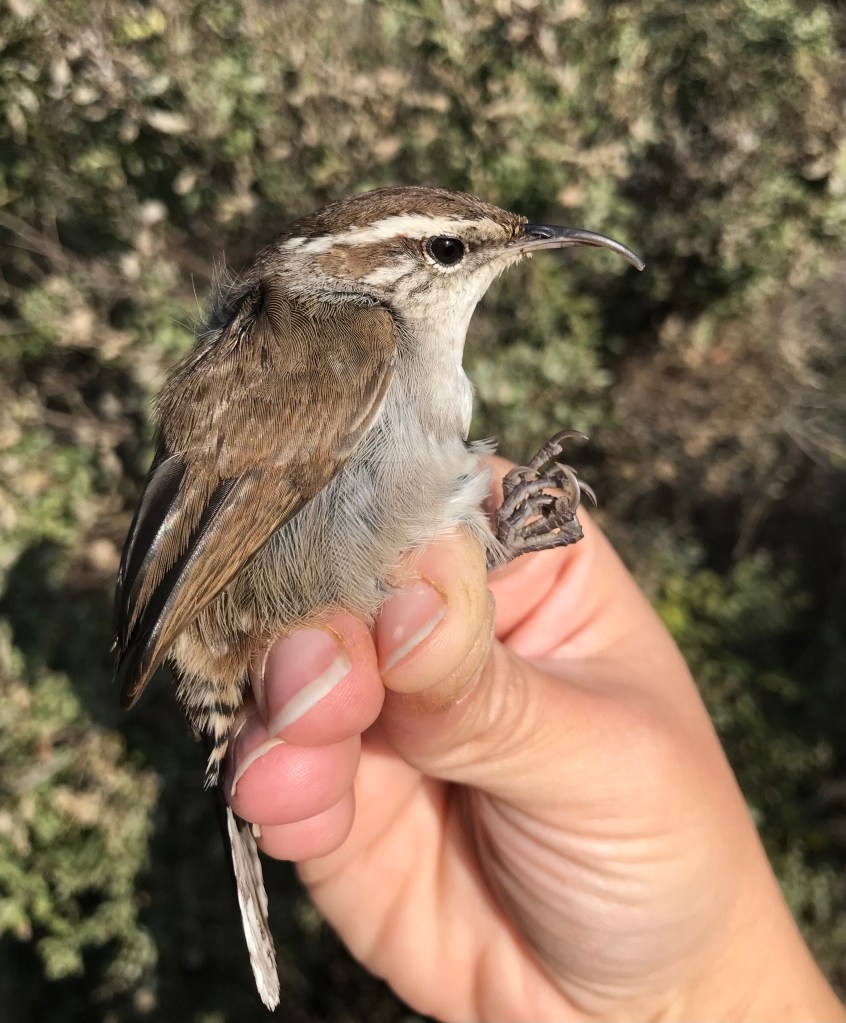
Photos


Credits
Emily Smith provided production assistance for this episode.
The following music was used for this media project:
Music: Spellbound by Brian Holtz Music
Free download: https://filmmusic.io/song/9616-spellbound
License (CC BY 4.0): https://filmmusic.io/standard-license
Artist website: https://brianholtzmusic.com
Transcript (click to view)
Michael Hawk owns copyright in and to all content in and transcripts of Nature’s Archive Podcast.
You are welcome to share the below transcript (up to 500 words but not more) in media articles (e.g., The New York Times, LA Times, The Guardian), on your personal website, in a non-commercial article or blog post (e.g., Medium), and/or on a personal social media account for non-commercial purposes, provided that you include attribution to “Nature’s Archive Podcast” and link back to the podcast.naturesarchive.com URL.
Transcript creation is automated and subject to errors. No warranty of accuracy is implied or provided.
Transcripts are automatically created, and are about 95% accurate. Apologies for any errors.
[00:00:00] Michael: Oh, got another little friend here. Oh, that’s a is that chickadee? This is a Bewicks Wren. Oh, no, it’s a, yeah. Bewicks in. Yeah.
[00:00:07] Wendy: So this is what I was talking about and it’s probably also gonna complain the entire time that I’m taking.
[00:00:13] Michael: Yeah, it’s definitely more tangled. It’s obviously in pretty good.
[00:00:17] Wendy: Yep. You never know.
[INTRODUCTION] Michael:
That is Wendy Gibbons, who is about to extract a feisty Bewicks Wren from a mist net at the Coyote Creek Field Station, operated by the San Francisco Bay Bird Observatory.
Have you ever wondered how bird banding works? How are the birds captured, safely handled, and released? And why is it done at all?
Thanks to Dr. Katie LaBarbera, Science Director for the Land Bird Program at SFBBO, we have you covered.
Banding is specifically the scientific technique used to study bird behavior, migration, and populations. By safely capturing and placing bands on birds’ legs, researchers can track their movements and gain valuable insights for conservation efforts.
Today’s episode is a unique one – it’s part field recordings and part traditional Nature’s Archive interview. We’ll jump into the entire banding process, from capture and extraction to the measurements taken and placing the band on it.
We’ll then discuss the outcomes and observations from this long term monitoring effort, along with some fascinating observations about birds ranging from American Goldfinch to Bewicks Wrens.
Katie also tells us about MOTUS, an exciting telemetry technology that will help create a network of automated observation stations to further advance bird migration monitoring. This technology promises to augment and amplify the work performed by banding stations.
And just one more thing. This was a really fun episode to produce, though challenging at times. A big thanks to Katie for allowing these visits despite a challenging season of weather disruptions, and having to re-record parts of it. Thank you to Wendy Gibbons, who walked us through the netting and extraction processes, as well as several other SFBBO volunteers who provided insights and information on my first visit in February.
So without further delay, Dr. Katie LaBarbera and the bird banding operation of the San Francisco Bay Bird Observatory.
[00:00:18] Michael: Okay, Katie, can you tell me about where we’re at right now?
[00:00:24] Katie: Sure. We are at Coyote Creek Field Station. This is a bird banding station that’s been running since the early eighties. It is located in San Jose, just. South of the bay. So just south of the salt ponds and mud flats and everything there we’ve got the Coyote Creek is what it’s named after.
[00:00:45] So it’s got a strip of riparian, woodland and then some restored woodland and then a meadow that is maintained for flood control
[00:00:54] Michael: . You band in each of those different habitats?
[00:00:57] Katie: Yeah. We set up mist nets, which is how we catch the birds. In all of those habitats, we see a lot of differences between the habitats and the birds we catch.
[00:01:06] We’ve also seen differences over time, say in the restored areas as the restoration has progressed. As the habitat has become more mature, we’ve seen differences in the birds there.
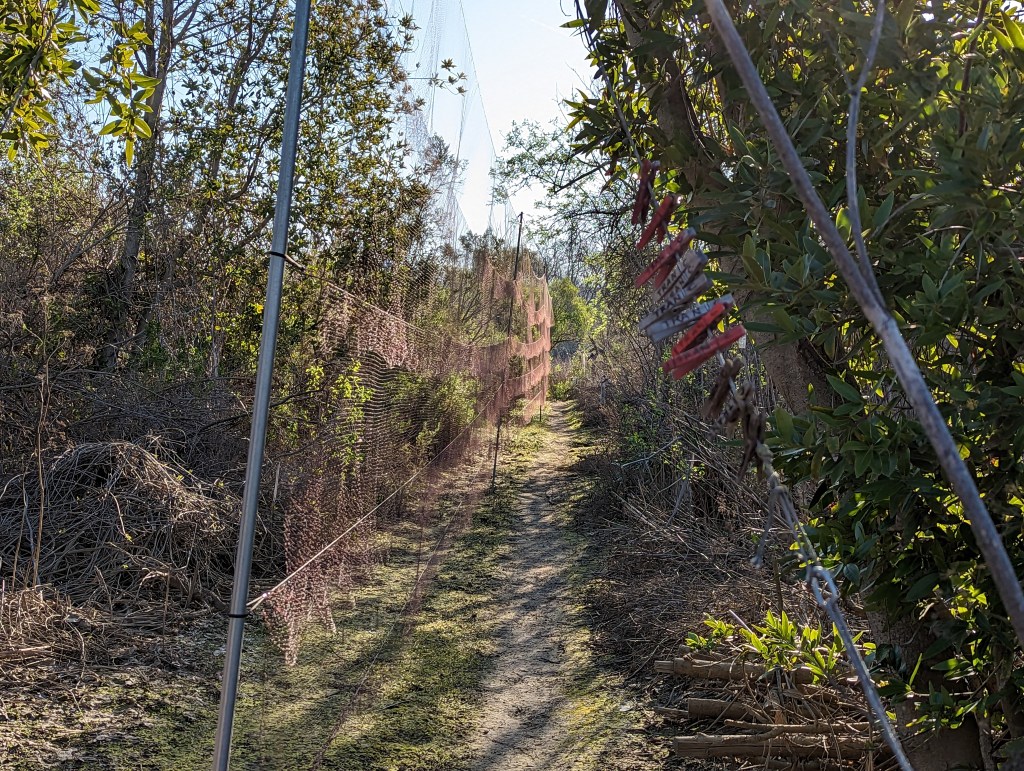
[00:01:17] Michael: So we’re walking along the net. That extends what, about 10 feet high
[00:01:21] Wendy: probably more than 10, probably more like 15. Okay. Yeah, this is a double net. So it’s actually got 10 panels in it and each panel is probably about 18 inches. And I’m not seeing any birds in this net.
[00:01:35] So we’ll go ahead and go to the next one.
[00:01:42] Michael: And you check the nets every 30 minutes. And why 30 minutes?
[00:01:47] Wendy: We don’t want birds sitting in the net for too long depending on what kind of bird it is. Some of them can get pretty stressed and they can also get really tangled if they’re in there for a long time. Plus, there’s also actually predators around that will come and try to get ’em out of the net if we leave them in there too long.
[00:02:06] All right, so I’m gonna pull the net down.
[00:02:11] Michael: So you have a special pole to reach up to the top of the net? Yep.
[00:02:16] Wendy: And we do it carefully because if we go too fast, then the bird will get double bagged, which means basically it’ll be twice as hard to get it out sometimes. Sometimes even more than twice as hard.
[00:02:29] All right. And then I gotta make sure I have that I’m on the right side of the net, which sometimes you have to like, touch the bird to see, cuz if it’s really in the pocket, it’s, Hard to tell. But um, this one I can see that it’s on, at least, I think it’s on this side. So I just, opened the pocket so I can see clearly where the belly of the bird is.
[00:02:52] Because it is very possible when you’re learning to ex try to extract them backwards by mistake, which it goes really badly, really fast. And then I just usually the wings are in the net, the holes in the net a little bit, and so you have. Like deese, almost like it’s wearing a sweater.
[00:03:12] You kinda have to pull the wings of the bird out. From the holes, which isn’t too hard. And then sometimes the the usually the feet I do last. And if I’m lucky, my trick is usually to see if the bird, cuz sometimes they’re actually really good at.
[00:03:32] They’re, if you just give ’em a little chance, they’ll be like, oh yeah, I really don’t want my foot cut and all that. And they’ll just, they’ll do it for you. Do it for me. Yeah. And this one’s not quite up for that. So then I’ll just gently grab at the base of the talons and then just work then that off the little teeny tiny talons.
[00:03:51] Cuz this is a. Yellow rumped to Warbler, and there’s actually two subspecies. so this one is probably an Audubon. Subspecies of yellow rumps. They’re probably gonna split the species pretty sp soon or they might but I can tell because he has a yellow throat, it’s probably a male and no white supercilium , which is like the line above the eye, and he has not been banded before he or she.
[00:04:19] And so when, when he goes back to the station, they’ll put a band on him and then if we catch him again, we’ll know that he was. From here.
[00:04:30] Michael: So now that he’s been safely extracted, you have to transport him back to the processing station. Yep. And I see you’re getting a bag out.
[00:04:37] Can you tell me how this next step
[00:04:39] Wendy: works? Yeah. So we put them in a nice cloth bag. These get washed every time because they’re a lot calmer. Once they’re not in your hand anymore, and they will actually stay pretty calm in the bag and it’s a lot safer for them when you’re trying to carry them.
[00:04:55] Very early this morning, one of the reasons why we have the so many nets closed is because we had, we were getting like 10 birds in one net, and so I had 20 birds hanging from here and, and the, they all have to go back and get processed and you don’t want them to be. Stressed cuz it takes a little while.
[00:05:13] So you want them to be as calm as possible.
[00:05:16] So I can just put ’em in here and very carefully close the bag, slide my hand. And I hold the bag against me so that my hand doesn’t slip.
[00:05:27] There’s a lot of these little tricks that you learn over a period of time about how to do it really safely. And then I close it with the little pin here, and then we label the bag. For the panel that it came out, so we know like roughly yet what height off the ground. The bird went into the net and then we also put a clip on for which individual net it was in.
[00:05:57] Michael: Um, Every net has an
[00:05:59] Wendy: identifier. Every net has an identifier yes. And then put him safely on a clip around my neck so he doesn’t get dropped. We have a system for the smaller birds getting the red clips because we want them to get processed first if possible. Just cuz they’re smaller. Just try to, give them priority uhhuh and then I’ll put ’em in here in my shirt to make sure, cause it’s still a little bit cold. It’s probably fine out in the air, but just to be on the safe side.
[00:06:30] Yeah.
[00:06:30] Michael: To be. Yeah. And the clips that you have, they’re closed pins that are all pre-labeled. So then it, then you don’t have to remember, you just put the clip on the bag and you know exactly what panel and which net.
[00:06:42] Wendy: Yep. Cuz if you get 20 birds, then you’re not, no way. You’re gonna remember. Not gonna remember.
[00:06:49] Michael: I was thinking as you were extracting the yellow rumped warbler I saw that you gripped it around its neck and when it’s still in the net, you can’t quite hold it, in a proper grip sometimes. I was wondering about that, like what was your decision process as to how to first get hold
[00:07:05] Wendy: of the bird?
[00:07:06] Yeah, so I pretty much always used the. Grips, but it goes pretty fast. So usually I do something called the body grab first. Before he, before my fingers went around the neck I had them But just under the wings and then a thumb on his belly. And then, because then I can get most of the net off the wings right away, like in. A second or two. And then cuz then he’s basically almost free. Then I would switch to the bander grip where my fingers are on either side of his neck very loosely, but just enough so he’s really secure.
[00:07:43] And I tuck the wings under the palm of my hand so that he won’t be flapping. Yeah. And then I can just finish pulling the net over the head. And then I do the feet last. And usually that works pretty well. Sometimes. There’s some birds like Wrens that just love to get super tangled up in the net.
[00:08:01] You just have to get creative and just keep working. At them,
[00:08:06] Michael: Are they more aggressive when they’re stuck in the net? Is that why they get more tangled or,
[00:08:09] Wendy: Grand wrens are really feisty, so that is definitely part of it. Yeah. But it’s also partly just the size they are because if the angle of the wing
[00:08:17] if it’s just the wrong size or the right size, depending on what you wanna call it. It will slide it through one hole and then it tries to pull it back, and then it slides it through another hole and it’s okay. Weaving itself through, you know, around the net and the tail gets all tangled and it’s grabbing with its feet.
[00:08:33] It’s just going, a little nuts.
[00:08:35] Michael: It it kind of reminds me of like untangling the chain of a necklace or something like that. He’s just yeah. Oh yeah.
[00:08:40] Wendy: So twisted in there. Yeah. Like when you have like yarn or something that’s tangled and you’re trying to get that last little knot out. Yeah.
[00:08:46] Michael: There’s another one.
[00:08:47] Wendy: Yep. We got one here and we got one here.
[00:08:51] Michael: So these nets they have these deep pockets in there, and
[00:08:55] Wendy: that’s really what captures them. Okay. Because a lot of times, if they like a. Sometimes a bird will fly in here and then actually just bounce off. And so what you want is you want them to fly in and then instead of when they bounce, they don’t bounce very hard and they just bounce right into the pocket.
[00:09:12] So the nets are actually made so there’s a little bit of looseness in them. So that the pocket is there.
[00:09:17] Michael: That makes sense. You don’t want it like a trampoline on its side. The bird just bounce. It might be fun for the bird, but not
[00:09:24] Wendy: helpful for her.
[00:09:24] The birds would much rather just bounce off. I’m sure.
[00:09:28] Michael: As we were talking, this yellow rumped warbler you extracted it in like less than five seconds and I think that’s demonstrative of the training and experience that you have in being able to get it out so quickly.
[00:09:39] .
[00:09:39] Wendy: Yeah, it’s probably not as hard as it looks with most birds, it is just, it’s more like that, that 10%, the one out of 20 or one out of 10 birds that just does get really tangled and.
[00:09:52] Fox Sparrows are another one. I had a couple Fox sparrows earlier. They have really long talons and very curved And they also just love to grab stuff. And so they sometimes they just get really tangled. Makes it a little bit more of a challenge.
[00:10:10] Michael: Oh, got another little friend here. Oh, that’s a is that chickadee This is a Bewicks Wren. Oh, no, it’s a, yeah. Bewicks in. Yeah.
[00:10:18] Wendy: So this is what I was talking about and it’s probably also gonna complain the entire time that I’m taking.
[00:10:24] Michael: Yeah, it’s definitely more tangled. It’s obviously in pretty good.
[00:10:28] Wendy: Yep. You never know. It could take me five seconds. It could take me five minutes. Hopefully not longer than that,
[00:10:35] what did you do to yourself?
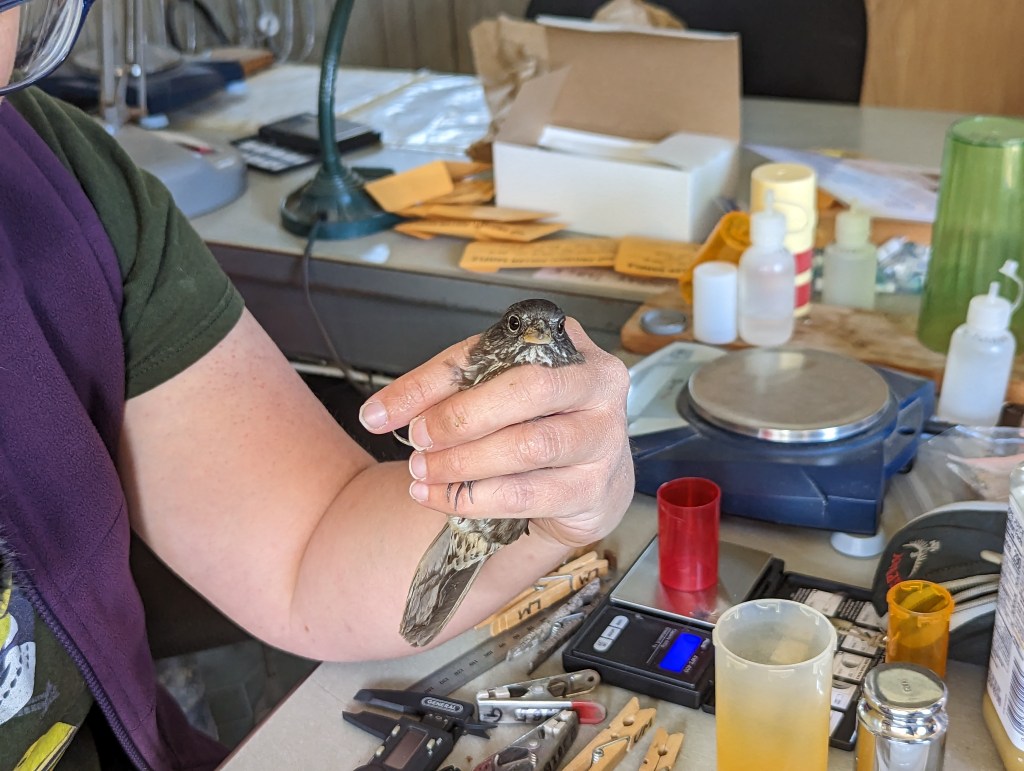
[00:10:39] Katie: so I’ve got a cloth bird bag here which is a cloth bag with a drawstring. It’s got two clips on it. One of them has the name of the net that the bird came from, and one of them has how high up in the net the bird was. I stick my hand in the bag and just make sure the bird doesn’t come out when I stick my hand in the bag.
[00:11:00] And I didn’t take this bird outta the net, so I actually have no idea what this bird is. It’s always a surprise. Feels like a big one. Oh, it is a big one. So this is maybe our second biggest. Sparrow that we get. This is a fox sparrow big chunky bird with a thick bill for eating seeds. Brown on top, white on the bottom with some classy brown chevrons.
[00:11:24] So we enter our data into computers. Is really nice cuz the computer can check our data. This bird was already banded, so he’s a recapture that is, as in we captured him once before to band him and now we’ve captured him again.
[00:11:39] So I’m reading the number off of his metal band. The metal band is around the leg. His number is 2 7 3 1 9 5 2 6 oh. So I put that in the computer and it says this bird has a capture history. I can actually look that up. We’ve caught him four times before. Oh, wow. The first time was in April, 2022.
[00:12:02] So just about exactly a year ago. And then this last fall in October and November, and then we caught him this year in February. So we’ve seen him a bit. So I’ve written down the metadata for this bird, which is when and where it was caught. It’s species and band number, and now I’m gonna take. Measurements of the bird. So I start out by actually making a sort of a narrow stream of my breath blowing on the bird in a sort of targeted way to part the feathers so that I can see past the feathers at the bird’s skin.
[00:12:34] That lets me look for. Fat on the bird as well as look for molting feathers. Birds have very translucent skin. It’s very thin, it’s very different from mammal skin. And so you can actually see under the skin, you’ll see a sort of dark red where there’s muscle and you’ll see a sort of orange red where there’s fat cuz fat is yellow.
[00:12:55] And so underneath the skin it’s it’s sort of orange. I’m gonna blow on the bird now.
[00:12:59] This is a very fat bird that’s always fun to see. He’s got fat at the base of his neck, where his collarbone is, that’s completely full of fat. He’s also got fat on his abdomen and on his sides in his wing pits. Birds of wing pits rather than armpits. So he is he’s a bird who’s doing well and he’s probably also planning to migrate out of here quite soon because birds get fat when they’re planning to go on a.
[00:13:31] So that’s cool. He’s, we probably caught him at sort of our last chance this winter to catch him. He didn’t have any breeding characters. That makes sense because Fox Sparrows don’t breed here. He’s gonna fly north and breed up north. I didn’t see any molt on him. His flight feathers are moderately worn.
[00:13:53] Too bad, but also not in perfect shape. Feather wear can tell us things about the age of the feathers, but it’s harder in sparrows because they go crashing through the brush so much that They’re just always a mess. Speaking of looking through the bird’s skin if you look through the bird’s skin on the head, you can actually see the skull.
[00:14:14] And young birds will have thinner skulls than older birds, and that shows up as looking pinker. and now I, Look past the bird’s head feathers to check for any pink patches on the skull. If he had those, that would suggest he’s a younger bird. It’s a bit late in the season for that to be the case.
[00:14:32] He’s old enough. Even if he had been hatched last year, he is old enough. I’d expect a complete skull, but we do always check.
[00:14:38] Yep. I’m not seeing any pink bits. He has a complete skull. In terms of aging him, I can say he’s an after hatch year, meaning he was not hatched in 2023. We age birds based on calendar year, so a bird is a hatch year. The calendar year it’s hatched. And then on January 1st of the next year, it becomes a second year bird because it’s, its second calendar year.
[00:15:02] So this bird, I can’t tell. It might have been hatched in 2022 or might have been earlier. Also can’t sex it because fox sparrows look the same for males and females. They are not sexually dimorphic. If he had an injury, I would record that. He does not. He seems fine.
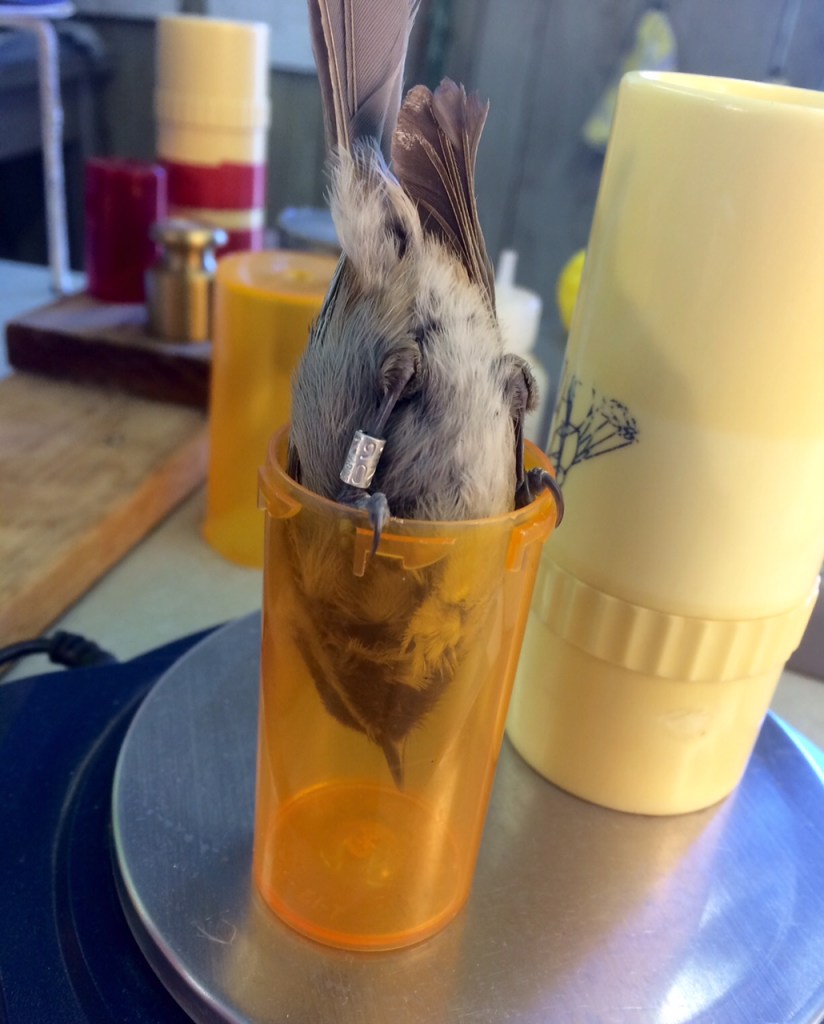
[00:15:19] And the last thing we do is we weigh the bird. We have a collection of cups. Think the smaller ones are like those old film canister cups. The larger ones are often pill bottles without the lids. Basically just think a cup with an open top, a cylinder with an open top.
[00:15:38] And we have a bunch of different sizes, so we can pick a size that is big enough to fit the bird comfortably, but small enough that the bird doesn’t, just turn around and fly out. I. Put the bird in the cup I just, put the cup by his head and kind of ease the bird down into the cup so that he ends up with his head at the bottom of the cup and his tail sticking out.
[00:15:59] And then I put them both on the scale. And this is just a good way to have the birds be confused and hold still for long enough to weigh them. He weighs 39.1 grams and then I take them back out of the cup and then he’s ready to go. so when I let him go I put him low to the ground in case he decides to hop. Instead of fly, I put a hand underneath him and then I take my top hand off and let him go. And there he goes, bye. And he’s all fluffing himself up, which they often do. We mess up their feathers.
[00:16:33] Michael: I, I like the fox sparrows.
[00:16:35] They’re they’re really
[00:16:36] Katie: classy.
[00:16:37] . Do you wanna do a different species?
[00:16:39] Michael: We’ll see what you have here. Okay.
[00:16:40] Katie: Yeah. My guess is it’s some kind of warbler, which would be different.
[00:16:43] So I’ve got another bird bag here. It feels a lot lighter than the last one. I’m guessing it’s some kind of warbler. This is prime warbler season for us. We still have our winter warblers, the yellow rumped warblers, . And we also have some of our early spring migrant warblers, like orange crown warblers and yellow warblers, and Wilson’s warblers.
[00:17:05] So this is a yellow rumped warbler. It’s another recapture bird. A bird that’s already been banded .
[00:17:12] And we get two different subspecies of yellow rued warblers, and we do try to ID them when we can. This one is a Myrtle warbler. The other option is an audubon’s warbler. I can tell the subspecies by he has a bit of an eyebrow, what we call a supers illium, and the pattern of his throat and white patches on his tail.
[00:17:34] And because he’s one of these warblers, I’m going to swab him for pollen because we’re contributing samples to a project to document what species of plant birds help pollinate. These warblers are not, dedicated pollinators, the way bees would be. But they fly around and will drink nectar if they can and pick bugs off of plants.
[00:17:59] And they may accidentally pick up pollen on their faces and then accidentally pollinate plants. I’ve got this sterile swab. It pretty much just looks like a Q-tip and I’m just running it over the bird’s face and over his bill.
[00:18:11] And then I put it in this sample tube and there we go. And will be sent to the student who’s doing that work, and we’ll find out what plants he might be pollinating.
[00:18:22] So after blowing on this bird, I can see he’s considerably less fat than the last bird. Just got a little bit of fat at the face of the neck. He’s in heavy molt. That is, he’s regrowing body feathers all over his body. These warblers do that because in the winter they have. Drab brownish, winter plumage.
[00:18:44] And then for the spring in the breeding season, they wanna get all gussied up for for attracting mates, , for breeding. And so they go through a molt in the spring called a pre alternate molt in which they replace not all of their feathers, but But a lot of their body feathers. And instead of being brown, they’ll turn this sort of nice blue gray and black and and just look more showy.
[00:19:07] So that’s what he’s doing right now. Since he’s in the middle of the malt, he looks patchy. He’s got some blue gray and some brown and some kind of naked bits, and he looks a little silly, but it’s, the work in progress. And then when he gets there, he’ll look really. So what’s the
[00:19:21] Michael: correlation between molt status and amount of fat they have?
[00:19:25] Katie: Yeah, that’s a great question. So definitely they’re using energy. That could be stored as fat. They are instead using to grow feathers. About a third of a bird’s body weight is feathers.
[00:19:37] So regrowing, even like half of your feathers is a big project. So that will limit the energy. They can store his fat. If he was molting his flight feathers, he probably would be limited in how much he could forage. Since he’s just doing his body feathers, that probably doesn’t come into it.
[00:19:52] But they’re also related in that birds usually. Try to avoid migrating and molting at the same time because both of those take a lot of energy. usually if a bird’s about to migrate, it will get really fat. If a bird’s molting, it’s usually not about to migrate, so it won’t have the pre migratory fat.
[00:20:10] his head, which I just looked at to try to figure out the skull, his head looks kinda like a porcupine because he is got all these new feathers growing in and they grow in looking like little pins. And looks a little odd.
[00:20:21] For the warblers, we record some additional things that we don’t take for the sparrows specifically. How much black and white there is at different parts of the body. How much black there is in the center of the feathers on the back. I’m recording. How many tail feathers have a white spot on them?
[00:20:41] This bird has white on the three outer tail feather. And how much black there is in the center of the upper tail coverts, which are the feathers right above the tail. Those can sometimes help us age and sex these birds. In this case, he’s in a sort of space of overlap between ages and sexes, so it doesn’t help us that much.
[00:21:03] And then I’m gonna weigh him with a much smaller cup and.
[00:21:08] This yellow rumped warbler weighs 12.8 grams.
[00:21:12] Bye.
[00:21:13] Michael: I wanted to follow up and get into some more of the details about the bigger picture of banding, not just the extraction and the processing of the birds.
[00:21:23] And really to do that and to provide the context. I wanna hear a little bit more about you. And lemme just start with, how did you get interested in nature in the first.
[00:21:33] Katie: Sure. So I was fortunate to grow up with a biologist for a dad . So I always. Was aware of there being animals around. I grew up in an apartment in Chicago, so those animals were things like silverfish in the pantry and jumping spiders. But we would always, get excited about the jumping spider and get upset when my mom would flush the silverfish down the sink.
[00:22:00] We weren’t a birding family,
[00:22:02] but I do remember when I was little one day walking me to school, my dad said, if you look at the house, sparrows, the ones that have the dark beards on their chest are the boys and the ones that don’t are the girls. And I thought that was the coolest secret that I knew that other people didn’t know.
[00:22:23] I don’t know why I thought it was a secret since clearly my dad knew about it. But I was always excited about birds. And then in college was when I really got into it.
[00:22:33] I. Took a course on the biology of vertebrates and we had the bird lab and I asked too many questions and the TA said, Hey, I have some really boring video scoring work that I need an undergrad to do. Would you like to do that? And I did that, and that was how I got started.
[00:22:53] Michael: That’s interesting. So a lot of people have a spark bird. It sounds like you actually came into this May, maybe the House Sparrow was a little bit of a spark bird for you
[00:23:00] Katie: Yeah, I think it’s probably the House Sparrow, which is so embarrassing, but they were the ones that were around I, thought it always looked fun to. Hop around inside the bushes the way they do, and I would see them, the males singing from corners, you know, in alleys so that the concrete would reflect their call and make it louder.
[00:23:20] Michael: Oh wow.
[00:23:20] Katie: so yeah, I’m afraid they might be my spart bird.
[00:23:23] Michael: I guess I don’t see a problem with that really. I know that they are invasive and can be problematic for some of the Native birds, but, They were the hook for you. It worked.
[00:23:32] Katie: Yeah.
[00:23:33] Michael: So your studies at university were generalist biology, or did you then begin to specialize, specifically into ornithology?
[00:23:42] Katie: My major was a section of biology that was systematics and biotic diversity. I got into doing bird research in freshman year and pretty much never stopped.
[00:23:52] , I was extremely lucky to be at Cornell, which I chose be mostly because it had a very dramatic thunderstorm when I was visiting and I thought it looked amazing. But Cornell has the Cornell Lab of Ornithology, which is probably the best place in the world to study ornithology.
[00:24:08] And so I just got really for.
[00:24:10] Michael: Nice. So then from Cornell, how did you migrate to San Francisco Bay Bird? Observ.
[00:24:18] Katie: I knew I liked research and I wanted to do a PhD and I. Had a partner at the time and he wanted to do a PhD in physics and we wanted to stay together. And so we applied for PhDs, in as undergrads we applied to go straight to our PhDs, which our advisors all told us not to do, and they were right to not recommend going straight from undergrad to a PhD.
[00:24:41] It’s exhausting and you will burn out. But we did that and that’s how I ended up in the Bay Area. I’d never really , spent more than a week in California before. So it was a bit of a culture shock. but yeah, so I came to Berkeley and did my PhD in a lab that, that mostly studies mammals, but was the behavior lab. And so they let me study birds because I was doing bird behavior.
[00:25:03] I was studying dark eyed junco which are a common sparrow. Around all of the us. I was studying them up in the Sierra Nevada mountains. when I was starting my PhD I knew how to band birds. That’s the part where you hold the bird and take all the measurements. But I didn’t actually know how to take them out of the mist nets that we used to catch them.
[00:25:24] So I needed someone to teach me that. And it turned out that the closest place to get that training was S F B B O. I found them because I emailed them and said, help, I really need to do a PhD and I need to know how to take birds out of mist nets. And Josh, who was the director at the time, said, sure, come down, I’ll train you.
[00:25:41] And he did. Yeah I dunno what I would’ve done otherwise. And that, that was my introduction to S F B B O and I just loved it so much that I, I kept volunteering when I could. But by the time they hired me, I’d been volunteering for four, four-ish, probably.
[00:25:56] Michael: I’m curious maybe from a personal. Interest the dark eyed juncos.
[00:26:01] Can you tell me more about what you were studying in particular with.
[00:26:05] Katie: . Dark eye juncos are special in that they are really successful generalists. They breed across a huge range of elevations. They breed at sea level and they breed up above the sub alpine tree line. That’s pretty wild. Most birds have a fairly narrow elevational range. I was thinking a lot about climate change. I think we all were and are but my department specifically was doing a project called the Grinnell Resurvey Project, where they were redoing surveys that had been done in mountains a hundred years ago to see how things had changed. And they were, of course, finding lots of things had changed from climate change. And so I was thinking about elevation and adaptation and responding to changes. And so the fact that jucos were successful at all those ranges made me curious about how they did that basically. And so I was I was looking for, what did they change about their life history, about their breeding behavior?
[00:27:02] Did they have fewer broods each season? Did they have smaller broods? Did they care for the chicks less? Things like that. Secondary big consideration for choosing Dark Eyed Juncos is that there are a lot of them and they nest on the ground. And as someone who’s five foot two being able to reach the nest was actually really important.
[00:27:22] Michael: A practical consideration, what conclusions were you able to draw from your study?
[00:27:28] Katie: So I found that they. Doing different life history things basically. But that it was a lot more complicated than I had realized because a lot of the differences were driven by differences in predation rate. So the ones that were say, having more broods per season, it wasn’t necessarily that they were purposefully having more broods per season, but it was that their brood were getting eaten and they were having to re nest.
[00:27:57] Michael: Kind of forced into it then.
[00:27:59] Katie: Exactly. Yeah. And it still was a difference because, the length of the breeding season determines whether you can renest. But yeah, it wasn’t I had drawn these very nice theoretical graphs and it didn’t quite match my very nice theoretical graphs. It also was complicated by extreme weather.
[00:28:14] Actually the higher elevation nest were a lot more likely to get. Destroyed by these really extreme thunderstorms that would happen at the high elevations. And that would drown the nest a lot. I still couldn’t tell you exactly why Junko specifically are engaging in all these different strategies while other birds are not.
[00:28:34] I think That’s a pretty tricky question about why some species are plastic and I couldn’t tell you, but but yeah, but I did find differences in patterns but arising from some things that I hadn’t anticipated,
[00:28:47] Michael: I know there are a lot of subspecies of dark eye junko. In particular
[00:28:51] Katie: yes.
[00:28:51] Michael: the ones in the Sierra Nevada. Were they all the same subspecies, or did you see any partitioning?
[00:28:57] Katie: They were all thurberi, so all the same subspecies. Yeah.
[00:29:01] Michael: very interesting. So hopefully somebody can pick up where you left off and answer the next layer of questions.
[00:29:07] Katie: I would love that.
[00:29:09] Michael: So we were talking a little bit about the property that the banding station is located on and the restoration efforts that started what, like about 30 years ago.
[00:29:19] Katie: Yeah, the first restoration started in 1987.
[00:29:23] Michael: Now I know that it’s not just the restoration on the property itself, that has changed the overall environment. But if we were to zoom out a couple of miles and look at a broader radius, the area beyond the station and the creek has changed quite a bit. So can you tell me a little bit about how that has changed over time and what impacts perhaps that has had on the composition of the birds that you see?
[00:29:49] Katie: Sure. So yeah, 40, 50 years ago it would’ve been all farmland. So when you’re thinking about Silicon Valley, you have to remember that the whole Silicon Valley thing is fairly recent. Before that, the South Bay was, farmland.
[00:30:05] And the banding station itself was pear orchard. As Silicon Valley grew and became a desirable place to work and live, the farmland disappears. And lots of urbanization. I guess is the general term. I mean, You’re seeing warehouses and strip malls all coming up around and the green really disappears off those satellite maps.
[00:30:26] It’s still not a really intense part of Silicon Valley. It’s not like there’s 40 story buildings there. But there’s an Amazon warehouse there. They’re about to build a Microsoft data center. We’re across the street from. Really standard strip mall that has grocery stores and Starbucks and In and Out Burger and everything.
[00:30:49] it’s a really different place than this just farm Fields place that it was not that long ago. This big sort of warehouse building went up just a couple years ago on the other side of the creek, and that has some lights on that stay on all night and it’s changed things that Microsoft Data Center is gonna go up in the next few years. That’ll be a big difference for us
[00:31:10] Michael: are you able to attribute any of those changes from urbanization to the types of birds that you’ve seen over the.
[00:31:16] Katie: It’s very difficult because so many things are changing over time in the same direction, like urbanization increases. As you move forward in time, so does the intensity of climate change. So does urbanization everywhere. So we have our urbanization, but also a lot of our birds are migratory and they’re experiencing changes all throughout their migratory roots, and they’re wintering or breeding grounds if they’re not here.
[00:31:48] So attributing anything to our local area specifically is really difficult. Fire frequency is increasing, drought is increasing, so many things are changing over time. So you can see patterns over time, but it’s hard to know what to attribute that to. Probably the closest you could get is by looking at our birds that just live here, our resident birds.
[00:32:10] So at least we can say they’re probably impacted by the things here and their. Going in all kinds of directions. The Bewick’s Wrens are exploding. They’re doing amazing. If you plot our captures it’s this exponential curve even interpreting that. That sounds good. Maybe it is good or maybe it means that all the bewick’s wrens in the area that used to live where that warehouse was now came and are living in our creek.
[00:32:38] Like it might actually not mean an increase in the population, but just a concentration of the population. It’s very hard to know Songs. Sparrows are another resident species. They. Are constant in their population, but they had a weird dip around, I wanna say 2015 ish. And they’ve recovered, but we still don’t know what that dip was about. It’s, yeah, it’s very hard if you’re not doing an experiment, if you’re just monitoring, it’s important to do the monitoring or you have no information. But it’s very hard to attribute it to specific things.
[00:33:15] Michael: Yeah, that makes sense. And it’s one of these things where in consideration of all of the other data that exists out there, you can start to draw some conclusions and you do see a trend. But yeah, knowing exactly what it is, it’s hard to say.
[00:33:26] Katie: Yeah so, we know that all across North America and even the world, we’re seeing. More intense impacts of things like climate change on long distance migrants. And we see that in our data too. And so seeing that broadly helps us say, okay, it looks like the fact that our long distance migrants aren’t doing so great probably is a sort of climate change thing.
[00:33:47] And not just that they specifically really hate Amazon warehouses. So yeah. Correlating with other data sets is really, I.
[00:33:55] Michael: Yeah I heard a really interesting characterization the other day. That I’ll relay here and I’ll see how it resonates with you and it’s like when you’re in a period of time where climate is stable, then that really drives a lot of niche partitioning and more complex lifestyles.
[00:34:11] And when things start to change or change rapidly, it really goes in the opposite direction. And you get a preference to generalists that are more plastic, that can, do more. Does that roughly correlate with what you.
[00:34:26] Katie: Yeah, I think that’s absolutely right. If you have to deal with change the critters that are good at dealing with change are the ones that we’re already handling a broad variety of conditions.
[00:34:38] Michael: So talking about then the data that you have collected over the years and trends that you’ve seen, do you have any headline observations to start with?
[00:34:48] Katie: I mean the bewicks wrens there’s a lot of bewicks wrens. The long distance migrant birds for us. That’s yellow warblers, orange crown, warblers, Wilson’s warblers. Were worried about them. They seem like they’re struggling and that’s not surprising and is probably due to a. Changes on their breeding grounds and on their wintering grounds, and also the fact that they have to fly across such a far distance when you know, in the fall now that distance is all full of fires and drought. We’ve had a few. Odd changes over time. So we used to get a lot of American goldfinches. They used to be one of our top captures. We now get one or two a year, and we really don’t know why. We get a lot of a very similar bird, the lesser gold finch. So it’s not that there’s not good things out there for goldfinches to eat. It’s been suggested that the American goldfinch, was a more agricultural bird, and so as the farm fields went away, they left two the. Timing kind of works, but not exactly cuz the farm fields haven’t been around for a while. Similar thing with house finches. We used to get massive flocks of house finches.
[00:36:03] The banders who have been around for 25 years will say that they used to have a rule that once you had banded and measured 20 house finches, you just started taking them out of the nets and letting them go. Cause it was too many house finches. Now we get, if we. Two in a day we say, Hey. Oh, cool.
[00:36:21] As a house Finch day. Again, I don’t know why house finches are not rare birds. Clearly they’re doing fine, but they’re not here anymore.
[00:36:30] We’re seeing the invasive birds that are increasing. We’re seeing that in our data. We had our first Eurasian collared dove ever a couple years ago. That’s a species that you know is non-native, but is increas.
[00:36:43] Michael: Have you had more since then?
[00:36:44] Katie: We haven’t, they’ve been around, we see them. They’re so big that they, it’s hard for them to get caught in the nets. So I think that’s the problem. But they’re definitely in the area.
[00:36:54] Michael: How about any.
[00:36:56] Interesting surprises over the years. Maybe it’s just like a really rare bird, or it’s a recapture of a bird that it was unexpected. Any anecdotes or stories come to mind?
[00:37:07] Katie: Anytime we get a bird that was banded at a different banding station, we get very excited. Couple years ago we got two Myrtle Warblers that had been banded up in British Columbia and Canada. That was really fun. They were banded at the same banding station and that, matches fine with the migratory route we expect them to be taking.
[00:37:27] But to get them, and to get both of them was interesting because that suggests that, this flock had stayed together from British Columbia down here, which is pretty. We got a Philadelphia Vireo not that long ago at one of our satellite banding stations. That’s a, that’s an East coast bird, so he’s not supposed to be here.
[00:37:46] that’s a vagrant bird. He got lost. Our hope is that he’s okay. Vagrant birds, often people find vagrant birds, heading out to sea and they don’t do so great. But But he was, in a good riparian habitat surrounded by other verios. And so hopefully, even though they’re not the right kind of verio, he’s all right and can get back.
[00:38:06] Historically we’ve gotten, cool vagrant birds that I wasn’t around for things like oven birds that I would love to see. If you band for, 30 plus years, you get a few cool ones but we don. We don’t really get to find out what happens to them, which is too bad because we’d have to get really lucky.
[00:38:22] Someone else would have to catch. The birds that really stick with me are actually the ones that are local that we catch a lot because then we get to learn their life stories. A number of birds have had, injuries and then come back from them, and that’s always really cool to see.
[00:38:37] There was a song Sparrow that turned up one time with half of his upper mandible missing, like the upper part of his bill. And then we recaptured him about twice a year for the next three or four years. And it grew back. He survived and his bill grew back and looked normal By the
[00:38:56] Michael: Was that known to, to be possible that a bird’s mandible could grow.
[00:39:00] Katie: The, I don’t know, honestly, like the most of a bird’s mandible is. Is like your fingernails is keratin and it does grow all the time. So that kind of makes sense. Like it’s not all just bone. But I certainly wouldn’t have thought he could survive long enough for that to happen. Also, I know. I’ve seen, rehabilitated two cans that lost half their bill, and they didn’t grow that back. They had to 3D print them a new fake bill. So I, I’m not sure that we knew that could happen. I don’t think. A bird hospital would’ve kept this song Sparrow alive to find out.
[00:39:36] I think they would’ve figured he would have a bad life, but yeah, he recovered. There’s a Bewick’s Wren we’ve been catching the last few months, who has a strangely overgrown upper mandible, sort of the opposite problem, so that he looks like a. I don’t know, a Sunbird or something.
[00:39:52] He’s got this big curved upper mandible and he continues to be fine. He’s nice and fat. I don’t know what he’s eating with his weird bill, but he’s doing great and carved out his own niche apparently. And then the other thing that I am really interested in that I’ve been I’ve published one paper on, and I wanna do more on it, is looking at bird’s, social behavior, using our data.
[00:40:12] Because for these flocking birds, it’s pretty common that we will actually catch a whole flock. We’ll catch, eight bushtits at once or eight. audubon’s and Myrtles warblers. And that lets us look at who is associating with who, which is normally really hard to tell with birds because they’re being sneaky moving through the bushes and if you put color bands on them, you have to be trying to read those color bands as they’re moving.
[00:40:39] And it’s very hard to see. And so we can look at our captures of flocks and see, who’s buddies with who is, does that last throughout their lifetime stuff like,
[00:40:48] Michael: Yeah, and it makes sense too that bushtits would be an excellent species to, to do that with I’m just picturing how they move from tree to tree or bush to bush where it’s one or two go and then a couple more, then a couple more, and then I could see them all getting captured at the same time.
[00:41:03] Katie: Yep. Sometimes. Sometimes you see that sometimes there’s a couple in the net and then you hear them, so you stand back and wait, and then the rest of them all come in.
[00:41:10] Michael: That, that makes for some busy time periods, to process all those birds.
[00:41:15] Katie: Not everyone likes that. I love getting a big flock of bushtits, but they are some of the hardest birds to get out of the net because they. They’re used to sort of clinging to things with their little feet, and so they clinging onto the net with their little feet Really.
[00:41:29] Michael: You read my mind a little bit as to where I wanted to go next and that’s, if you had more resources, more money, more time, what would you want to research?
[00:41:38] Katie: there, there’s a lot of things the social behavior question is my personal interest. It’s also Always feels a little bit frivolous in what often feels like the climate change end times these days. So I would like to do that. I would also really like to do some more restoration focused stuff that, that would be expensive.
[00:42:01] the restoration one patch was restored in 1987 and the other patch was restored in 1993. We know. They worked pretty well. So we did a study looking at the vegetation structure and the biodiversity and also the bird community that we’re using these habitats.
[00:42:16] And it’s not bad. It’s pretty close to the remnant riparian patch that we can use as a comparison. But we can also see that these habitats look like they might not last long term. They’re really struggling with the drought. The trees that were planted are nice, big trees now, but they’re struggling to successfully create the next generations.
[00:42:37] I would love to, go down and figure out where the groundwater is and monitor that to see, is it really the drought? And we think it is. Is it really? I would love. Try to think about what we could do with the habitats next to get out in front of climate change and keep these viable habitats.
[00:42:56] It might be, I have a, colleague who’s been suggesting that they really, at least one of the, one that’s further away from the creek, really needs to transform into oak woodland because it’s not gonna be able to be riparian. I. Be interested in trying to figure that out so that we make sure that there is habitat out there.
[00:43:14] And then the one that sort of satisfyingly covers both bird behavior, which is my self-indulgent interest and conservation, which feels more urgent right now, would be to track habitat use and migration in the birds. So put trackers on the birds and see for our local birds. Where are they going?
[00:43:34] What places are they using? What is giving them good habitat and for our migrant birds, where are they going on the broader scale? Do we think that anything we do here could help them? Or is the issue, their wintering grounds down in Columbia? And then, we would know that and we could try to focus on that.
[00:43:53] . And
[00:43:54] Michael: then shifting gears you mentioned the Motus Tower. Yeah, that’s relatively new here.
[00:43:58] Can you tell me how Motus works?
[00:44:01] Katie: People have tried to track animals in a lot of ways for a long time. And bird banding is actually one of those initially one of the big reasons you banded birds was with the hopes that someone else banning birds would catch your bird and read the band, and then you could figure out where the birds were going.
[00:44:16] You can also track animals using, say, GPS trackers. Communicate with satellites and figure out exactly where the animal is. But then you have to catch the animal again to get the tag back. There’s some very heavy tags that can actually, connect to your phone and then you can just watch where the, whale goes in real time.
[00:44:35] But again, you’re kind of attaching those to things like whales because the tags are very heavy to have all that battery and ability to communicate and everything. MOTUS is. A system for tracking animals that is aiming to be accessible to even very small animals. So you wanna keep the tags very light and it’s aiming to Amplify the resources of the scientific community because a big problem with tracking is that the individual tags are usually expensive and any given study, you have funding for maybe 10 or 20 tags, and then, okay, you’ve answered your question and then that money’s gone.
[00:45:13] A Motus tower is basically just an antenna with a computer attached and the antenna will. Motus tags that come within its range, that range depending on the landscape and the length of the antenna is somewhere between one and 10 kilometers.
[00:45:27] You will know what the range is. It just varies depending on the specific situation.
[00:45:31] Michael: And look like the antenna is a omnidirectional.
[00:45:33] Katie: we have an omnidirectional here. Yeah. There you can also get directional ones that go further. Yeah. So a single motus tower is just that antenna.
[00:45:41] Reads a tag that gets close, it knows exactly which tag that is. And on its own, it’s just gonna tell you is any animal that someone tagged within this range of me. The beauty of MOTUS is that every MOTUS tag and every MOTUS Tower works with each other.
[00:45:58] So if you have a group with a, fairly small research, over here in the South Bay, and they put up a Motus tower, and then you have another group in the East Bay and they put up a Motus tower, and then you have maybe Fish and Wildlife puts up a tower at Eden Landing, you can make this grid of Motus Towers, and it means that everyone who’s.
[00:46:17] Put a tag on an animal now gets all the geographic data of all of those towers combined. It lets everyone amplify their own resources by, instead of, tracking 10 birds and then you’re done. You are contributing to this sort of commonly held. Tracking system. And if I’m not
[00:46:37] Michael: mistaken, like you can go on the MOTUS website and see Yep.
[00:46:40] Like anybody can do this. Go cool and see the data. It’s cool. Yeah,
[00:46:42] Katie: yeah. If you go on the MOTUS website, you can see where the antenna are, what the ranges are. You can look at what birds have been seen, or not even birds. So people use it for bats. They’ve used it for dragon flies. You can use it for a lot of these small flying cri.
[00:46:57] Michael: I like the dragonfly thing because, so it’s, I don’t think commonly known that there are migratory dragon flies too. so that’s, gives a good visual as to how small this technology can support.
[00:47:07] Katie: Yeah, just think about how light a dragonfly is and that they have to, not only do they have to be able to fly with this tag on it, but if you wanna understand their behavior, you need to not be impairing that dragonfly. It needs to be doing its natural behavior, so you have to be light enough that a dragonfly doesn’t really notice you. Which is, yeah, pretty wild. And you
[00:47:26] Michael: were mentioning that in order to start actually attaching these tags, there’s another licensing process that you have to go through.
[00:47:33] Katie: .
[00:47:33] So anything you do with birds, with the exception of the three invasive species that we have the pigeon, starling, and house Sparrow. Any bird besides that if you wanna do pretty much anything to them, you need a number of permits. You need one from the federal government, and then you need one from the state that you’re.
[00:47:52] That permit will say specifically what you’re allowed to do. You’re allowed to hold them and band them, say, or you’re allowed to hold them and ban them and put a tracker on them. But each individual action is a specific thing. And so we currently have permits to hold them and band them and do a number of other things, but we never had needed to put trackers on before.
[00:48:13] So we’re waiting now. Our update to our permit approved to add tracking and getting that permit approved. What they check is, are the people on this permit? Do they seem qualified to attach trackers to animals? Do they have a good scientific reason to do that? It’s a check to make sure that you’re not just harassing wildlife For fun.
[00:48:29] Michael: And that’s a good thing that yes, you’d wanna check for that. Absolutely. , once you get that permit, how do you anticipate this station using MOTUS? Would there be specific species that you focus on or other parameters that you would use?
[00:48:41] Katie: Yeah there’s a few species of interest we have.
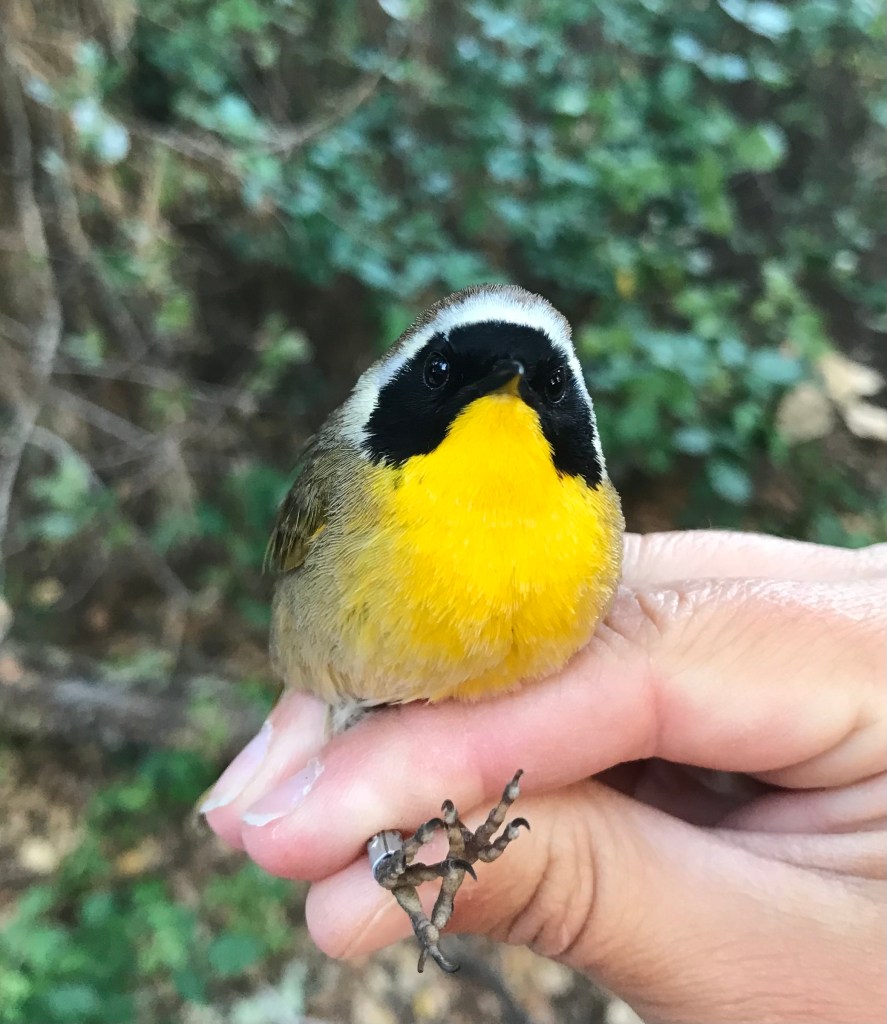
[00:48:44] So we have two subspecies here that. Special concerned species for California. One of these is a subspecies of the common Yellow Throat, which is a cute little yellow warbler with a black face, black mask. And the Salt Marsh or San Francisco Common Yellow Throat is a subspecies that is endemic just to the San Francisco Bay area.
[00:49:05] And we don’t know that much about them. They are thought to have different migratory behavior from all the other yellow throats. But. Based mostly on just a few pretty old at this point, studies. And so we would really like to put tags on them to see what they’re really doing, what habitats they’re using their salt marsh specialist.
[00:49:27] And salt marsh is, a habitat that is decreasing in the area, but also there’s some restoration going on. And so seeing, where, are they still thriving? Are they using some new habitats? All stuff like that would be really. The Alameda Song Sparrow is another subspecies that that is endemic to here.
[00:49:45] They’re, again, they’re salt marshy and they’re not as much of a mystery in terms of migration. But just in terms of, again, what habitats are using and because they’re sort of a local special species. We would also like to look at hermit thrush and s Swainson’s thrush. They are migrants that we get through here.
[00:50:03] The hermit thrush is winter here. The s swainson’s thrush is pass through on their way mostly in the spring and fall migration. But there’s a lot of evidence that migratory birds are being impacted. Climate change by all this extreme weather. And so their migration, timing and roots are changing.
[00:50:22] And we would love to track these swainson’s thrush and thre and hermit thrush too, to see how they’re migrating. So
[00:50:27] Michael: then if you happen to capture one of these species Yeah. Then your, flow chart would say, okay, after you do all the other measurements, then you attach your MOTUS tag.
[00:50:37] .
[00:50:37] Katie: We would want, for the common yellow throats, they are small enough that we’d wanna make sure we had a bigger one because we’re right. On the edge of too small for the tag. So we want to get a good buffer, to make sure we’ve got, a really good big bird. We want a common yellow throat over nine grams.
[00:50:51] And I
[00:50:51] Michael: want to just clarify. So the smaller common yellow throats are, Lighter weight than the large dragon flies.
[00:50:59] Katie: So some of it has to do the dragon flies. I think when they’re using motus tags, they probably are using tags with a battery life of a week. Oh, okay. So yeah. So the heavy part of, so the smaller tags, yeah.
[00:51:09] So the heavy part of all these tags is always the batteries. Yeah. And so yeah, with a dragonfly, I think they have very small batteries and they’re just getting a short lifespan. We would like to, Birds for longer. Yeah, totally makes sense. But no, birds are very light.
[00:51:23] They’re mostly air under those feathers. But yeah, so we would maybe weigh it if it was a common yellow throat. We would check that it was a healthy bird. We wouldn’t wanna. Do anything to a bird who wasn’t having, having a good time. So maybe make sure it has at least a little fat that it doesn’t have any, illnesses or anything.
[00:51:40] Injur Yeah. Injuries. But yeah, but then we would have the tags. They would be. prepared and there’s a lot of checking you do around the tags to make sure that they’re actually on and that you’ve got the right numbers and everything. But yeah, but then you would just attach it.
[00:51:53] It doesn’t take that long to attach you. You use it’s not fishing line, but it’s that kind of thing. Think something very thin and very strong to attach it onto the bird. There’s a couple of different attachment methods. There’s backpack harnesses and then there’s leg loop harnesses.
[00:52:08] But They’re all designed to basically keep the mass of the tag centered over the bird center of mass, not interfere with the bird’s movements. Let it fly, let it do all the things it wants to do. But yeah, you just put it on the bird, check the fit, make sure the bird moves fine and let it go.
[00:52:24] And it should be a pretty short process. You’re trying to have the bird be pretty much a normal bird, so you don’t wanna impact it.
[00:52:30] Michael: So thinking back, have there been any top of. Events, or maybe it’s a book or a movie or a documentary or something that really escalated your interest in the natural world or perhaps you would recommend to people to check out.
[00:52:44] Katie: I would always say the Beak of the Finch is an older book, but is really great. It’s a description of studying bird behavior and evolution and responses to the environment all at once.
[00:52:57] And also a sort of almost utopian vision of. Field science life that almost nobody gets to pull off and isn’t really any more a realistic aspiration, but is really lovely to read about. So the beak of the finch is really nice. I read that as an undergrad and had fantasies of living on the Gala Galapagos and, 24 7 keeping track of the Finch soap opera dramas which is hard to do, although I’m actually pretty close given that I live 20 minutes from the banding station and do actually keep track of all the bird soap opera dramas.
[00:53:30] So maybe I got pretty close there.
[00:53:32] Michael: So one other thing that I often get really interesting answers to is this question.
[00:53:35] And that’s, if you could magically impart one ecological concept to help the public see the world as you see it, what would that.
[00:53:44] Katie: Yeah. I like that question that I think so I would say, Nature’s never done like there. There’s sometimes there’s an idea when we’re thinking about evolution or natural systems that, ev evolution was the past and then it got here and now it’s done, and. These ecosystems are all a finished project.
[00:54:07] We talk, we think about food webs and things, and it’s all this incredibly intricate thing with lots of interactions and lots of species, dependent on lots of other species, and it, it looks like this. Incredible intricate tower or clockwork thing that exists, you know? and if you take a piece out, then it all falls apart.
[00:54:25] And that, that is true. If you remove something, everything changes. But the key thing to remember is that everything is always changing all the time. The natural state of anything is not stasis species are. to try to take advantage of new niches, new opportunities. They’re always competing with each other.
[00:54:46] The environment is always changing. Even if we, climate change is a lot more extreme and consistent in one direction than would be normal without human influence. But even without human influence, there are dry years and wet years. There are earthquakes mountains get taller and then erode. Birds get blown off course and wind up on an island and then colonize that island and then suddenly you have 18 species of birds on an island. Things are always changing. And both to think about that in kind of a.
[00:55:21] Kind of an exciting way like, you know, keep an eye on things, what is changing around you. But also, for me at least, that feels a little bit more like a call to action. Yes, humans have changed things and we’re gonna keep changing things and we can’t stop changing things, but that doesn’t mean we’ve just broken everything.
[00:55:40] And you just have to sweep it into the garbage. It, It means that we can continue. To change how we change things in ways that will let natural systems adapt better and continue to coexist. Really simple things like what you plant in your yard will change that little micro ecosystem and you’ll see different species take advantage of it.
[00:56:02] And so just thinking of yourself as a as a part of this constantly changing system that you. One little force of change in I think I would like people to think about that way. And so think about, how can you affect the change a little bit. And then also, you have a front row seat to a lot of cool stuff that’s happening.
[00:56:22] And keep your eyes open and don’t miss that.
[00:56:24] Michael: I think that’s a helpful and hopeful point of view as well. Because you’re pointing out that we don’t have to give up we don’t need this defeatist point of view because, give nature a chance and yeah, we can modify our behaviors to give a better chance.
[00:56:39] Katie: I’m not gonna promise everyone that the polar bears are gonna make it or something, Buick’s friends are nature too and they seem to be doing okay.
[00:56:47] Michael: Do you have any upcoming projects or anything that you’d like to highlight?
[00:56:51] Katie: We’re continuing to try to progress with the MOTUS tower tracking that we talked about. It’s still one more tower to put up and then hopefully put some trackers on the birds, so that will be really cool.
[00:57:03] Michael: That’ll be a big day when you put the first tracker on.
[00:57:06] Katie: That’ll be really exciting. Also we’re hoping to put a different kind of tracker, actually the heavy GPS trackers that just talk to you constantly. We’re hoping to put those on flickers. And that will be really cool. That’s probably not gonna happen until next year, but I’ve never. I’ve never actually gotten to have a little computer screen with the little dot that moves in real time with the animal. That’s always been a little bit of a, a scientific fantasy of mine and so I’m really looking forward to when that happens. But the main thing is we just wanna keep going.
[00:57:36] We wanna keep monitoring, we’ve been monitoring for these many decades and we don’t wanna, stop. And there’s always something going on. I mean, There’s gonna be spring migration soon, and then the breeding season, and We’ll see if the Hutton’s verios breed again. Last year we had the first time that Hutton’s Verios bred at the banding stations. I’m curious to see if they do that again. Just little stuff like that is
[00:57:57] Michael: Yeah, there’s always something interesting. The closer you look at something, the more interesting things you find,
[00:58:02] Katie: exactly, and the harder it is to explain to other people.
[00:58:07] Michael: So if people want to follow your work personally or the work that’s being done at S F B B O or the banding station in particular, where can they.
[00:58:15] Katie: Sure. So SFBBO o has a website which is sf bbo.org. If you. Search around that website, find the science projects part and the land bird part. The banding station has its page that links to copies of all of our papers that we’ve published with little abstracts that should be readable to people who don’t read scientific papers every day.
[00:58:41] The papers are there for two, of course, if you wanna actually check out the, the graphs and everything. There’s also a blog that couple times a week I’ll put a photo of a interesting bird that we got recently and some notes on why I was interest. That’s on that website. And we have a monthly email that SFBBO sends out that tells you about events and talks.
[00:59:04] We have a lot of virtual talks. We started doing them during covid and it turns out that people really like to be able to listen to a talk, while they eat dinner instead of having to go somewhere. Yeah, I do recommend those. There’s a big range of, everything.
[00:59:17] Someone walking you through her garden and talking about the birds she sees to, postdocs and professors talking about 10 year research projects.
[00:59:25] Michael: Well, As always, I’ll make sure to link to all of the different resources that you mentioned to make it easy for people. It’ll be on the show notes. Okay. Katie, thank you so much for all the time that you’ve spent and walking through the banding operation
[00:59:38] it’s really been a pleasure. I appreciate the work that you are doing and the SFBB O is doing.
[00:59:43] Katie: Thanks so much, Michael. This is fun.
 Nature's Archive Podcast